🎧 Audio (12 mins) - I talked through this in audio form if you’d rather listen.
When Everything Depends On You
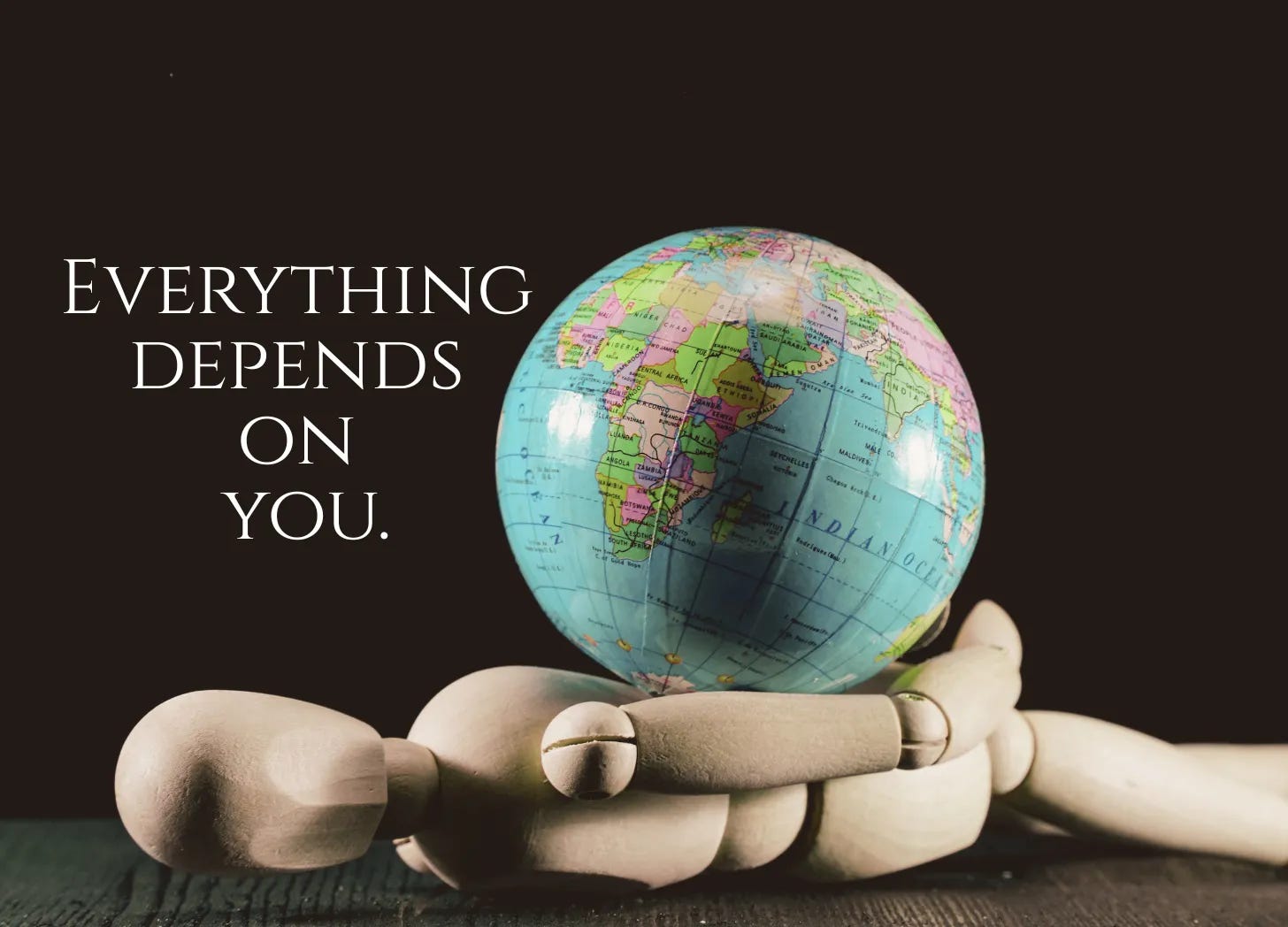
When everything depends on you, you feel it, in your bones, in your stomach, in your heart. The pressure can feel like the weight of the world is on you. And if you let go for a second, that world will roll right out of your hands and out of your control. So you keep your hands on the ball. You stay alert. You hold it together. You keep stepping in, just in case everything really does depend on you.
But you don’t just feel the weight of the world; you interpret its reliance on you through the filter of what you believe about God. And anxiety reveals that filter.
Which means anxiety is not just what we feel, it’s how we interpret life. And when that interpretation involves God, we are doing theology.
Theology is reasoning about God; it’s how we interpret our lives in relation to who He is. That means the moment anyone answers the questions :
Who is God? What is He like? How does He relate to me? What does He require? What can I expect from Him?
We all do theology. We just don’t always know that’s what we are doing. But in order to believe, you have to interpret. When anything happens in your life, suffering, an unanswered prayer, anxiety, a closed door, you interpret that event in light of who you think God is. That’s theology. And what we believe about God shapes what we see, whether it’s true or not.
If you have something in your life that is unbearable, or even hard, and you decided it’s because God is disappointed in you, that’s theology. If you think He’s just teaching you patience, that’s theology. And if you think you need to try harder, that’s your theology at work in your mind.
Every reaction to your lot in life rests on your assumptions about His divine character.
Suffering Forces Theological Decisions
Suffering exposes your theology the way a mid-term exam exposes whether you understood the material. You can say you trust God all semester, but suffering grades that claim.
In Job, Job’s friends walked into the exam room confident. They thought they knew the material. Their theology was simple: God punishes people for their sins, and that punishment shows up as suffering. If someone is hurting, God must be correcting them.
So, when Job started to suffer, they told him he failed the class. It was obvious to them. The test results were in: if God is just, and suffering is punishment, then Job must have really messed up.
But their theology assumed God runs the world on a tight cause-and-effect system. The problem wasn’t that they believed God judges sin. The problem was that they believed they understood exactly how and when He does it.
In this instance, Job’s suffering exposed the limits of their theology.
The Self Your Theology Creates
You are not only doing theology when you think about God. You are also doing theology when you think about yourself because who you believe yourself to be is inseparable from who you believe God to be.
If you think you have to manage everything because “God helps those who help themselves,” or in order to be a good steward, that is your theological framework (though not a biblical one). If you believe that only God is sovereign, and that He has all the power to do what He wills, and His will is for your good, not to harm you, then that theology changes your anxiety, your performance, and your identity.
In other words, your ideas of yourself are born in your doctrine. Union with Christ, justification, sanctification, these aren’t seminary topics only. They shape how you will wake up tomorrow.
Messianic Over-Functioning
None of us operates in a theological vacuum. We are all absorbing cultural assumptions, family narratives, and emotional reactions from others and baptizing them as truth. And most of the time, we do it unconsciously.
This is nothing new to the church. That’s why creeds were written. Not to make us all academics, but to safeguard us from distorted images of God. And that’s why I have the practice of taking my theology and seeing how it functions practically and emotionally in my life. I want to protect myself from misreading God in my nature, the world, and the actions of the enemy.
The difference between your spiritual stability and your spiritual turbulence comes down to whether your beliefs align with who He has revealed Himself to be.
If you have ever thought:
“Everything depends on me.”
“I have to fix this.”
“If I fail, everything falls apart.” Then you know what you functionally believe about God, sovereignty, and your human responsibility.
Even if you say you trust God, your nervous system behaves as though the universe runs on your vigilance, on your ability to manage everything. And that is the fuel for anxiety. That doesn’t mean every experience of anxiety is theological error. We are physical people with nervous systems, shaped by our trauma, our chemistry, and our history, but even within those realities, what we believe about God shapes how we interpret what we feel.
If you believe that if you relax, chaos wins, that tells us you are trying to do a job that was never yours to do. Someone once called the feeling that you have to fix everything, messianic over-functioning, and I think that’s a great term. It’s burdened self-salvation, the Savior complex, and it elevates your ability to repair stuff above His divine timing.
Anxiety’s Creed
For a lot of us who struggle with anxiety, this is our theology, and it hurts to even say it:
The system is only as strong as my performance.
His grace is not enough to sustain failure, mine or theirs.
My preparation holds everything together.
I have to step in, in case God doesn’t.
If I don’t act, nothing changes.
My action is the stabilizing force.
If I relax, chaos wins.
These statements imply something about God’s sovereignty, presence, and trustworthiness. That is theology by implication.
The Reality
But true Biblical theology says this:
The system is upheld by God’s sustaining power, not my consistency.
His grace is most visible at the point of our failure.
My competence is a contribution; God’s sovereignty is the foundation.
God’s activity does not depend on my intervention.
Change ultimately flows from God’s will, not human urgency.
Christ is the stabilizing force; I am a participant.
Rest is an act of trust, not negligence.
God can be trusted even when it looks like He can’t.
Examine Your Creed
Your theology is what you believe about God and the implications of that belief on your emotional system.
So, the ultimate question isn’t whether you are a theologian because you just are. The question is, what kind of theologian are you becoming under pressure?
When anxiety rises, listen carefully to the sentences that surface in your mind. They aren’t random. They are your creeds.
“Everything depends on me.” “If I don’t hold this together, it will fall apart.” “If I rest, something will break.”
Those are theological statements. And if your body is exhausted, tight, vigilant, it may be faithfully responding to the god you believe in.
So maybe the work isn’t first to calm the nervous system, maybe it’s to examine your creed.
What do you actually believe about sovereignty? About grace? About how much of the universe is riding on your shoulders?
And if you discovered that you have been unconsciously carrying a role that was never assigned to you, what would it feel like to set it down?
I’m not asking you to answer that right this second, just notice what comes up today, tomorrow, or the next day. Pressure has a way of revealing the creed we actually live by.
If you’re noticing anything about your own thinking on this, please share. I’d love to hear your thoughts.
Hayley, this was so well said. What great therapy advice—to look at our beliefs about how life works (our theology) and to just begin noticing what we're thinking. I so appreciate your vulnerability in sharing your distorted cognitions like “Everything depends on me.” My version is similar: "I've got to figure everything out so that I can get it right. If I don't, God will be mad." Your writing is so rich with valuable content. I always love to hear what you have to say.



Hayley, this was so well said. What great therapy advice—to look at our beliefs about how life works (our theology) and to just begin noticing what we're thinking. I so appreciate your vulnerability in sharing your distorted cognitions like “Everything depends on me.” My version is similar: "I've got to figure everything out so that I can get it right. If I don't, God will be mad." Your writing is so rich with valuable content. I always love to hear what you have to say.