


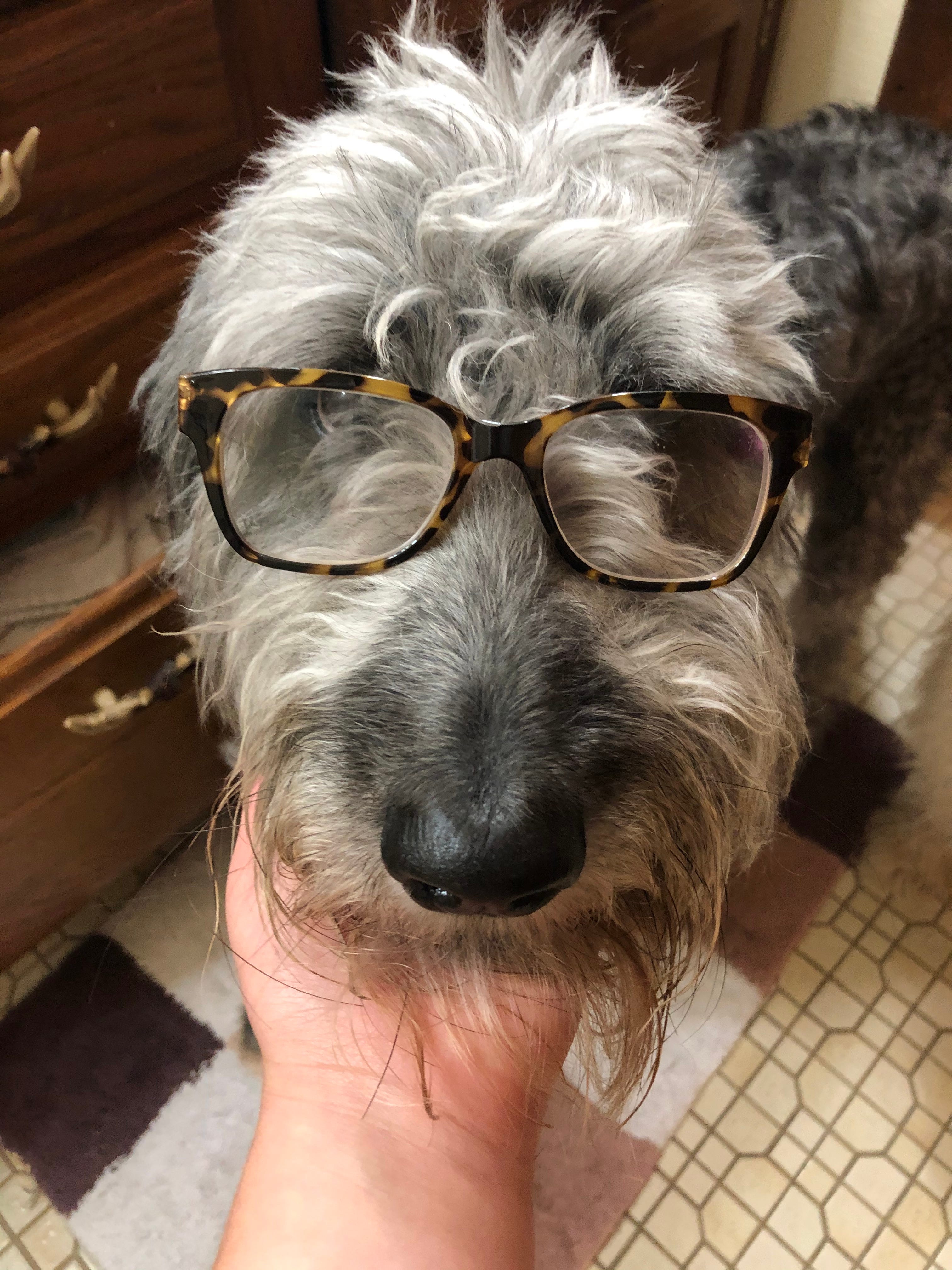
My goldendoodle picks up anything she can find and delivers it to me like a cat delivering a dead mouse to my doorstep; a thoughtful gift wrapped in the ugly paper of frustration. And, if I don’t see it or receive said “gift,” she keeps it for herself and chews it up. Clothes on the floor, AirPods on the coffee table, glasses on my bedside table, she’s obsessed with fetching them. At first, I was so upset, especially when I didn’t notice her offerings. Let’s just say, we went through a lot of socks and AirPods until I started to realize that her “shopping,” as we call it, was only possible because I hadn’t put things away. If we leave a sock on the floor, she’s going to get it. Meat on the counter, it’s as good as got. The girl seems to be obsessed with anything that is out of place and out of my sight.
For years, I yelled at her and chased her until I realized that if I put things away as soon as I was done with them, she’d have no place to shop. Which turned out to be a real gift. See, I’m a neat freak trapped in a messy girl’s body, but because of her frustrating “skills,” I’ve been forced to escape my messy nature and to come out the other side the neat freak I’ve always wanted to be!
Do you see what I see? I didn’t become tidy by resolving to be tidy. I became tidy because keeping my dog from ruining my stuff became more important than being “too tired” to clean up. My dog “helpfully” removed the option for me to stay messy. So, what started out as frustration (once I finally took a look at the result) became a blessing. Benefit-through-friction, they call it; a situation that initially feels punitive or irritating but ends up reshaping your behavior in a way that gets you exactly what you wanted, but never believed you could achieve.
I didn’t catch this pattern because I was trying to grow; I caught it because something kept removing my ability to live unchanged, and anxiety has been the same for me.
How, you ask?
Good question, because it’s taken me decades to see the “benefit” of my anxiety in that it has stripped away any illusion of total control, not my agency, but my incredibly false belief that I could manage everything. Not that I’m saying that anxiety itself is sanctifying or good for you, but my anxiety exposed how often I was living as if I were responsible for knowing everything and holding everything together, and slowly taught me to let God take back those jobs.
This then worked its way into my prayer life. By the sheer need to hand my hyper-vigilance over to Someone who’s capable of handling everything I need handled, my prayer life has increased.
That led me to the conclusion that anxiety has led more people to pray more honestly than confidence ever has. Not because anxiety is good, but because weakness is a visual reminder that you just can’t handle it all yourself.
But the pain of anxiety doesn’t just inspire prayer; it makes weakness undeniable, and that is where power shifts to the only One who actually has it, thus collapsing the illusion that I was ever the strongest presence in the room. “My power is perfected in weakness” is not praise for anxiety, which is my weakness; it is a statement about where divine sufficiency becomes real to me: when my self-sufficiency is no longer viable. You could say that prayer born from weakness is like an oxygen mask dropping from the ceiling. You don’t debate it. You don’t perfect your mask breathing technique before you use it. You just put it on because breathing suddenly matters more than anything else.
Both psychology and theology agree: growth grows not through your wanting it alone, but when friction removes any option to live life unchanged. And maybe this just sounds like self-help to you. But self-help assumes you still have the strength to help yourself. Surrender starts when that assumption collapses.
The trouble is, the spiritual disciplines are often taught like they’re elective courses; pray more, trust more, surrender more. In that sense, they start to sound like self-help: techniques for managing yourself better. But that’s like telling me to “just calm down” in the middle of a panic. It assumes capacity that isn’t there. Prayer doesn’t work because it’s assigned; it works when it becomes the only way left to hand the ever-present weight you are carrying over. Biblically, most disciplines find their legs when self-management pulls a hamstring. My doodle removed the option for disorder in the same way that struggles, like anxiety, remove the option of independence.
Spiritual disciplines are often misnamed. Many are not practices we adopt, but responses we are trained into when God dismantles our ability to live independently of Him. Struggle itself does not produce virtue; it removes alternatives. Prayer, trust, and reliance become ours not because we choose them, but because everything else stops working.
Prayer born from weakness; it’s not disciplined spirituality; it’s survival spirituality. And once you see that, it’s hard to unsee where your own self-sufficiency has already started to limp.
I love your dog illustration. But I don't always appreciate God squeezing me into situations that force me to change!