

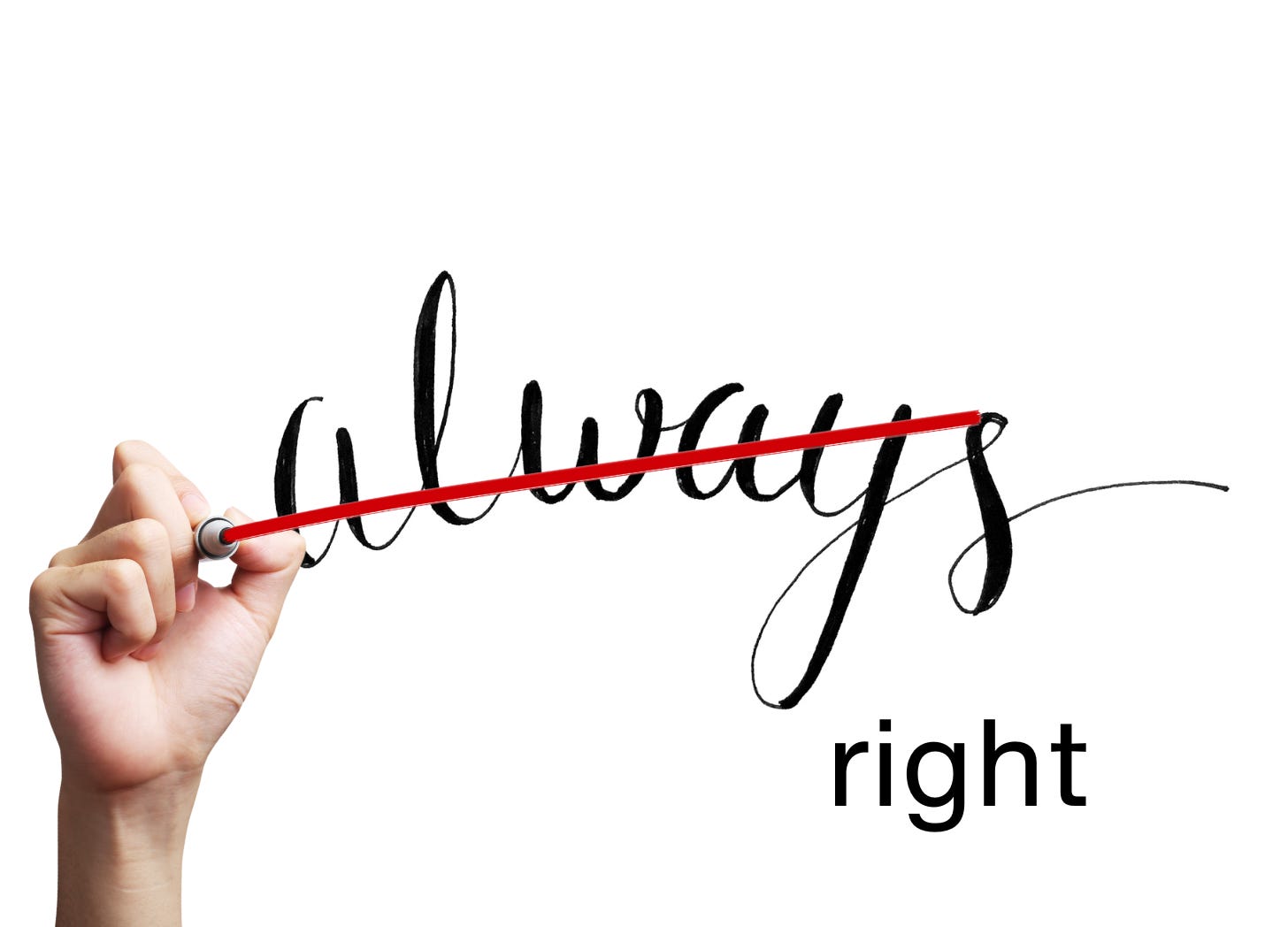
I always think of myself as right. After all, I don’t hold opinions if I think they are wrong. That would be crazy. I don’t stand for stuff I know isn’t right. I know what is good and what is bad, and I choose good every time. I guess you could say that I am always right. Why would I approve of something or do something if it were wrong?
Thus goes the inner workings of my mind, as I comfort myself with the idea that I am right and you are wrong.
When you stop too quickly in front of me, and I run into you, it’s your fault.
When I stop suddenly in front of you, and you run into me, it’s your fault.
When you are short with me, you’re being unkind.
When I’m short with you, it’s because I had a hard day; give me a break!
This sense of my own rightness and your wrongness has led me to be surprisingly opinionated. And came with the gift of being incredibly cynical. I can mock people who don’t agree with me, from the comfort of my own home, with such agility and finesse that anyone would be on my side if only they could hear me.
I guess you could say I have the gift of obstinacy. After all, if you’re right, you’re always right. So, why wouldn’t you hold fast to your “right” beliefs?
I may be a bit of a troublemaker, if I’m being honest. But I mean, with this kind of certainty, how could “I” be wrong? It just doesn’t seem possible.
Or so I used to think.
Believe it or not, this attitude has made me difficult to live with. I’m not mean by nature, but I am opinionated and in my mind, therefore, always right. I guess that makes me perfect, doesn’t it? Perfect = not wrong in any of my opinions or beliefs.
But then I’m left with a conundrum: in my worldview, there is no one who is or ever was perfect, except Jesus.
It just can’t be. The Bible confirms it, and I believe it. There is no one perfect, not even one.
I guess I gave myself a pass because I held to the idea that I wouldn’t believe or do anything that wasn’t right, only a fool would do that—do or think things they knew weren’t good or right, choose to be something that wasn’t good or perfect. But in a great shift of irony, that’s exactly what I was, a fool, because I believed I was perfect. By thinking that I was always right in word and deed, I was making myself imperfect: wrong.
We are all flawed because we are all human. Show me one human who was never wrong! We just can’t be right all the time.
Figuring that out has led me to question myself more.
What was the origin of the error?
Because the moment I can admit my distance from perfection—my mistakes, my blind spots, my wrong turns—I stop pretending to be perfect, and in a twist of irony, that’s when I actually start to move toward it.
As I was reading God’s Wisdom for Navigating Life, by Tim and Kathy Keller, I started to see myself in the fools the book of Proverbs describes; in the mocker, the obstinate, the troublemaker, and the unreasonable.
That started me on a weird journey of self-discovery, with the goal of finding out the error of my ways, so that I wouldn’t be a fool thinking I knew it all and was doing it all right. I probably sound like a fool just saying that. Forgive me, but this is a process of humiliation (in the best sense of the word, I hope).
This has been the posture of my obstinate heart for the past decade or so. It has been a slow process. I am obstinate and opinionated, and I find it hard to let go of my belief that I am always right, but over time, it has become easier.
I have become more willing to be wrong. More interested in confessing that wrong and turning around and going in a completely different direction. The Bible says that confessing your sins to one another and praying for one another is the path to healing, and it is true. Though confession is embarrassing, it is cleansing, and when my head is out of the sand, the view is surprisingly much, much better.
I was once called a narcissist for thinking about myself so much, and that grieves me. My goal is the complete opposite of a narcissist’s goal. I’m searching for ways to empty myself of all that is selfish and conceited, arrogant, argumentative, and cynical.
So, if you find my confessions arrogant, I am sorry. I don’t want to lead anyone to stumble. I can only pray that you will find some solidarity and similarity between us as you, too, seek to move closer and closer to the image of the Creator who is all-loving, all-merciful, forgiving, kind, gentle, and patient. I have a long way to go, but that’s why I’m so bent on this journey.
It’s taken me a long time to assume this posture, but I’m so happy that I have. This desire to burn off the dross of my life is a gift, and I want to make the most of it each day.
So, thanks for being a part of the journey. I pray that your path will also be filled with joyful self-discovery, humility, and confession, as you also find that what you thought was right is quite possibly wrong.
Does that sentence scare you? It shouldn’t. The only way not to be wrong is to actually be open to the idea that you might be wrong. Isn’t it ironic, don’t you think?
If you are willing to risk being wrong, then have a look at these types of fools found in the book of Proverbs. Finding yourself in the description isn’t a bad thing, but a step towards letting go of your own foolishness.
And be of good cheer, foolishness is the natural state of man in the same way that the natural state of my house is to become a mess. And in the same way, if you want it to get clean, you can’t just ignore it. So which fool are you?
The Cynic, everyone is problematic to the cynic. They view everyone but themselves as being selfish and motivated by self-interest alone. They give very little grace to others. They are true pessimists. (See Proverbs 1:22).
The Simple, their hearts are easily swayed by the dramatic and spectacular. They see themselves as optimists. They want the approval of others. They are drawn to forceful personalities and often lend their support to leaders who promise peace and prosperity without discernment. Their minds are intellectually lazy, unwilling to ponder or deeply contemplate the truths of life. (See Proverbs 1:22)
The Obstinate, they stand resolute, unwilling to give up their position on any given subject. They don’t like being wrong or being corrected and don’t want to be taught by others, but would rather learn it or discern it themselves. They consider themselves realists. (See Proverbs 1:22)
The Troublemaker, their love language is complaint. They would rather confront than just walk away in peace and humility. Their conversations effortlessly omit the other side of the story. They are very comfortable telling themselves and others half-truths and incomplete narratives. They are pessimistic in their outlook. (See Proverbs 6:16,19).
The Sluggard, they are the embodiment of laziness, unwilling to put in the effort required for self-improvement. The deep contemplation of life's mysteries is too much work for them. (See Proverbs 6:6-11)
The User, their love is selfish, which means it’s not love at all. They can be careless and even ruthless. Though they might not even be aware, their goal in every relationship is to satisfy themselves at the expense of others. (See Proverbs 1:16-19)
The Unreasonable, they disregard advice and reject rebuke. They lack joy and cannot handle the sunlight of wisdom touching their hearts. (See Proverbs 1:25-26)
The Narcissist, they deny flaws in themselves and put the blame on others. Everything is okay, and there is no need for introspection. They lack self-awareness and focus on an optimistic worldview that doesn’t involve them needing to grow. (see Proverbs 21:24)
I may be a fool for even writing this down and sending it out, but that’s the pessimist in me that I’m seeking to ignore from here on out. I used to think being a pessimist just meant I was worried because I always expected the worst, but now I see that makes me not just a pessimist but a fool. So, here I go. So long pessimism, and so long cynical troublemaker.
Love the “ so longs”.😊❤️
Truth! Thanks for your bravery as well as honesty. Great words of encouragement and exhortation.