

I always like the original most. I like original Coke. I like the original VW Beetle. I like The Original Pancake House. I like the first iteration of things because that’s how it seems they should be.
Which is probably fine when we’re talking about cars, but it gets a little more complicated when the original thing is me. Because apparently I’m just as attached to my original words, thoughts, and ways of doing things as I am to soft drinks. I chose them, after all. Why would I want someone coming along and suggesting revisions?
Unfortunately, as an author, I’ve had to repeatedly live through the editorial vandalism of a person whose job it is to make sure I haven’t mistaken my first version for my best one. Editors just love to mess with what’s “working” and “improve” it when I don’t see the need.
To me, writing is like decorating. I chose the words I liked to create the environment I wanted to share, so when an editor comes along and tells me “This part over here isn’t working,” I’m insulted.
I mean, I said it because I wanted to say it. It makes sense. And it’s the exact environment I wanted to create.
Clearly, you don’t understand what I’m doing.
At least that’s what I tell myself while I’m having my editorial hissy fit. Unfortunately, once I’m done defending my brilliance, there’s an irritating truth I have to admit: I may be too close to the project to see the difference between what I meant to say and what I actually said.
But still, the fact that I know why every sentence is there, and they’re all there because I chose them, means I’m compelled to defend their existence.
That’s life, isn’t it?
I know why I said what I said.
I know what I meant.
I know why I’m impatient.
I know why I’m suspicious.
I know why I’m controlling.
That’s exactly why an editor has an advantage: they have no such attachment. They can see what’s confusing, unnecessary, inconsistent, or just not doing what I think it’s doing, and that’s why, despite all my complaining, I guess I need one.
When Life Gives You Editors
Unfortunately, the editorial process doesn’t end when I close my laptop because everyone around me is an editor, an editor of my character. My husband is deft at editing my reactions. My child can spot an inconsistency between what I preach and what I practice before I’ve made it to the period. And my friends can cut my word count with a single uncomfortable look.
But let’s be honest, good writers don’t accept every edit they’re given. They first ask themselves whether the edit makes the work better, clearer, stronger, and more faithful to what the book is actually trying to accomplish.
That’s especially true when the thing being edited is me.
After all, I’m not going to change myself every time someone doesn’t like something about me. Another person’s approval can’t become my editorial standard.
But since I’m too close to the project to see everything clearly, I should at least be willing to consider the edit, right?
Their approval aside, the question is, is what they’re seeing consistent with what I say I believe. Maybe they’ve spotted something in me that doesn’t look much like Jesus. And maybe that’s a passage worth revising.
Eventually, though, I feel like maybe I could start catching some of these things myself. Self-editing, if you will.
I hear the way I just spoke to him.
Edit.
I recognize that I am rehearsing an offense again.
Cut.
I notice myself exaggerating because the truth doesn’t make me look quite innocent enough.
Rewrite.
I realize I am doing something I have told other people not to do.
That definitely needs to be deleted.

Self-Editing
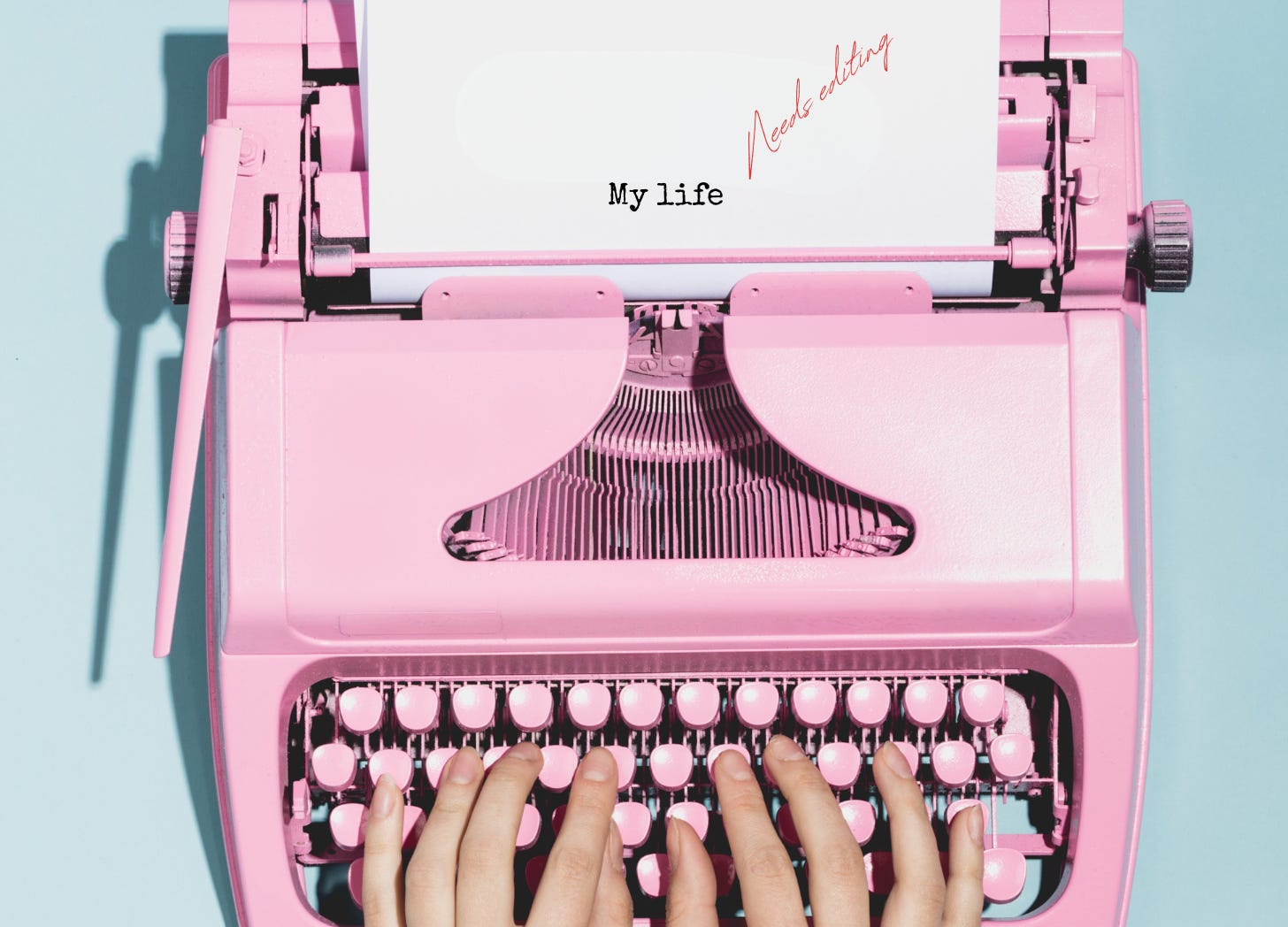
The trouble is, I’m much better at spotting the edits everyone else needs. So I usually bring God the manuscript that is my life and point out everything He needs to change in the other characters. “Revise the difficult person,” I say. “Remove that troublesome chapter, improve the ending, correct everyone else’s dialogue.” Meanwhile, the red pencil just hangs over my own paragraph.
Maybe I’d be less defensive about accepting it if I remembered that an edit isn’t a wholesale rejection of the manuscript. Sometimes you cut a perfectly good sentence just because it doesn’t belong in the book you’re trying to write.
Of course, knowing what to cut is one thing. Actually cutting it is another.
Blaise Pascal once said something Mark Twain gets most of the credit for. Writing to a friend, he apologized for the length of his letter because he hadn’t had time to make it shorter.
And that’s the irritating thing about editing: cutting can take a lot more work than adding. There’s even a name for the tendency to overlook the cut: subtraction neglect. When trying to improve something, the tendency is to look for something to add, even when taking something away would work better.

And I do the same thing with myself. I tend to assume that in order to grow, I need more faith, more discipline, more knowledge, more effort. But growth isn’t always about adding something that’s missing. Sometimes you just gotta remove something that doesn’t belong. Not because everything I cut is terrible or every edit is better than my original, but because maturity means being willing to look at your life and say, “I know why that’s there. I may even love it. But it doesn’t belong in the final manuscript.”
Which leaves me with the uncomfortable task of looking again at the pages I’ve been so busy defending and asking whether they belong there, or whether I’m defending them simply because I wrote them.