


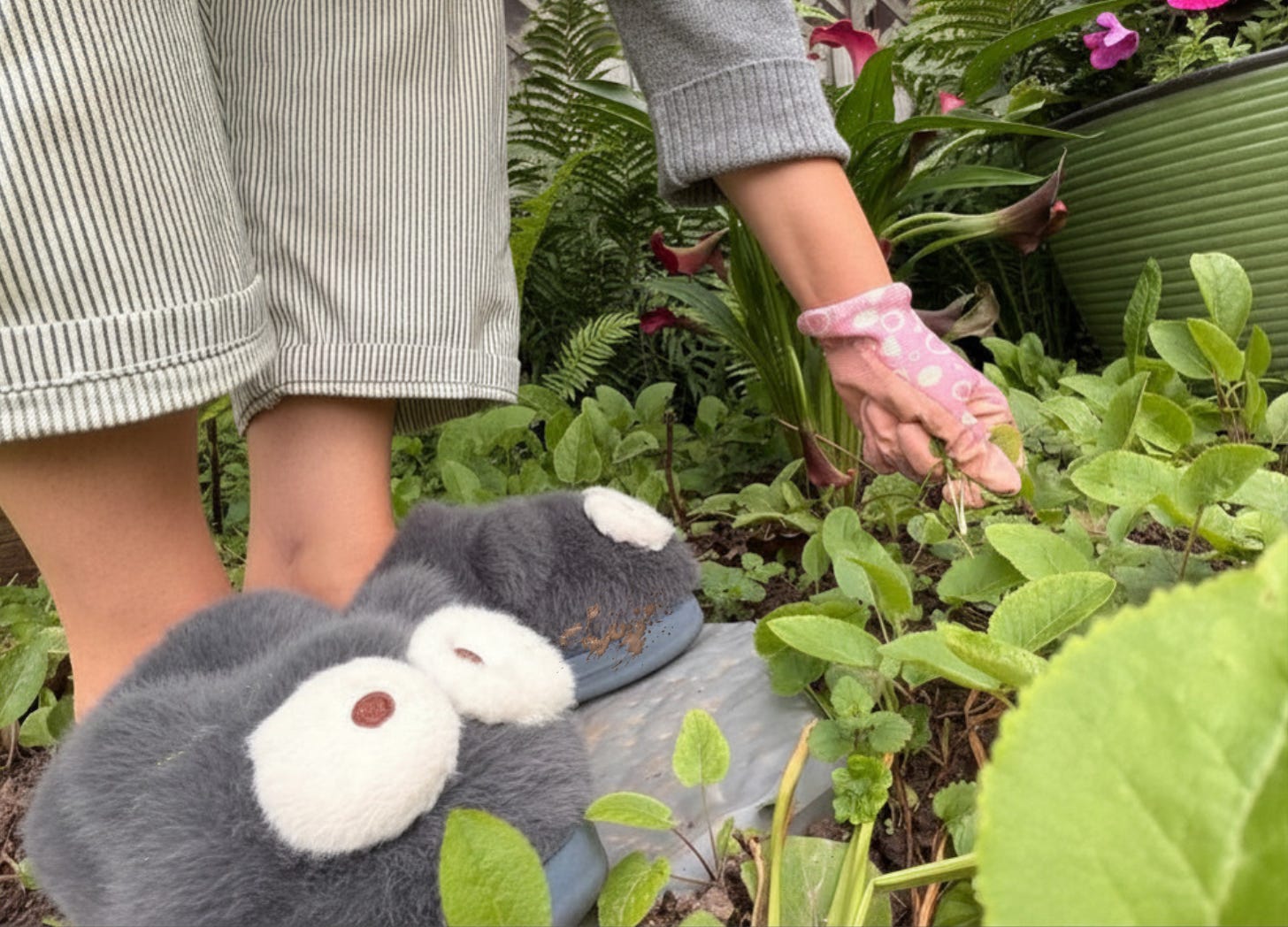
Today I’m out working in the garden and need to go inside for something. For some reason, I am still in my slippers, not in my gardening shoes. So, I walk up to the sliding glass door and take off my slippers, put on my garden shoes, and walk inside.
A minute later, I’m standing at my kitchen sink, looking down at my muddy shoes, and thinking, when were these allowed inside?
I changed my shoes without even noticing I was doing it. I was so busy thinking of the weeds in my patio stones and how to get rid of them, and if I should go to Home Depot, and while I was thinking about all that, my feet quietly took care of business.
That got me to thinking about how our brains are so complex that they can carry out complicated actions based solely on what we’ve taught them through repetition, like putting on shoes or driving to work, while simultaneously working out other mental problems. It’s like we’re running two programs at the same time.
Which then got me wondering: Could faith have a thinking side and a practicing side? Could that explain why we can believe God while simultaneously struggling to trust Him?
If my behavior is evidence of an invisible mental program, could I find an invisible spiritual reality underneath? Is this what James was getting at when he said, faith without works is dead? (see James 2:17)
After all, faith is invisible. So how do you know it’s there? James says look at what it produces. He even says, “You believe that God is one; you do well. Even the demons believe—and shudder!“ (James 2:19). Apparently, knowing the truth and trusting the truth aren’t always the same thing.
James never says, “Tell me about your faith.” He says, “Show me.” Like a doctor diagnosing an illness from its symptoms, James looks beyond your profession to your works. Not because works create faith any more than symptoms create disease, but because they reveal whether the faith we profess is the faith we get to live.
Which makes me wonder if faith isn’t first revealed in my explanations, but in my reactions. In other words, faith may be less visible in what I can explain than in what I instinctively do.
While my mind was busy solving the weed problem, my feet just did what years of repetition had taught them. Could my reactions do the same thing? Could they reveal what my heart has learned through repetition?
Don’t get me wrong, I’m not saying faith is just a habit, like driving to work or putting on shoes, but that repeated returning to and trusting in God shapes your patterns just like repeated shoe-changing shaped mine.
Your thoughts reveal what you’re processing.
Your reactions reveal what you trust.
Just like while I was consciously deciding what to do about weeds, another part of me was unconsciously changing my shoes.
Maybe that’s why Jesus repeatedly put people into situations where their automatic responses would reveal what was in their hearts.
He put them in a storm. Asked them to feed more people than they had food for. He invited Peter to step out of the boat. He came late to the funeral of Lazarus. Again and again, He put people in situations where their reaction showed what their hearts instinctively trusted in.
That’s what makes your works important, not their saving power, but their diagnostic power. Works show us where our hearts instinctively run when life becomes frightening, uncertain, or impossible.
Suddenly, James makes more sense, doesn’t it? While what he’s telling us is that our works reveal our faith, they also are an insightful diagnostic tool, revealing the habits of our hearts.
If our reactions reveal what we’ve been practicing, then the answer isn’t just more knowledge. It’s a different response. We repeatedly respond to life's difficulties as though God is trustworthy, even when doing so feels unwise or unsafe, until trust becomes more and more our first response.
So maybe faith is more like putting on my shoes than working out the weed problem, because:
Putting on your shoes is learned.
Driving is learned.
Piano is learned.
But what about prayer, trust, gratitude, generosity?
Can those become so practiced that they start to shape your actions and even your feelings? I think they already do.
The question isn’t whether we’re being formed. The question is what we’re being formed by. And I think that’s exactly what spiritual formation is meant to do.
Through repeated acts of trusting and obeying God, He gradually reshapes the patterns of our lives until what once felt unnatural starts to feel increasingly familiar.
Jesus said, “A good tree bears good fruit,” which tracks because fruit isn’t manufactured moment by moment; it grows from what the tree has become over time. Just like we become the people we repeatedly practice being.
It's a slow process, but now, every time fear tells me to rehearse disaster, I just see another opportunity to practice trust instead. Having that plan in mind makes me less inclined to protect myself when life gets stressful.
Of course, I can attest that the first few times you choose trust over worry, or gratitude over grumbling, or prayer over panic, it feels unnatural, dangerous even. That’s because we’re practicing a new pattern while the old one still feels more familiar.
But familiarity isn’t the same as truth.
We've already seen this principle at work. My shoes didn’t change because I made a dumb decision that day. They changed because I’d practiced that pattern so many times it had become automatic. And trust becomes increasingly natural the same way. So. . .
When you think, “I'm afraid we won't have enough money,” your first instinct might be to start worrying about everything that could go wrong.
But the practice of trust says, “I’ve already done what wisdom requires. Fear isn't going to improve my future.”
When you think, “I’m afraid I left the door unlocked,” and you want to check again.
The practice of trust says, “I’ve already checked the lock. My peace isn’t found in another look.”
“He is the lock on my door.”
If you’re afraid a new pain means something terrible, don’t scan your body. That just creates a pattern of distrust and fear. Instead, practice trust and say, “My focus is my God, not my imagined disease.”
And if you’re worried people are disappointed in you, don’t replay the conversation. Practicing trust means thanking God for them and praying for them. And then moving the conversation onto the One who will never leave you nor forsake you.
None of those responses starts by changing your feelings. They start by changing where you run.
Fear asks, “Where will I run?”
Faith answers, “To God.”
And every repeated act of trust patiently teaches your heart where to run first the next time.
“I look up toward the hills. From where does my help come?
My help comes from the LORD,
the Creator of heaven and earth.” —Psalm 121:1–2
If this raised questions about why our brains learn fear so quickly in the first place, I explored that in Is Having Anxiety a Lack of Faith?