


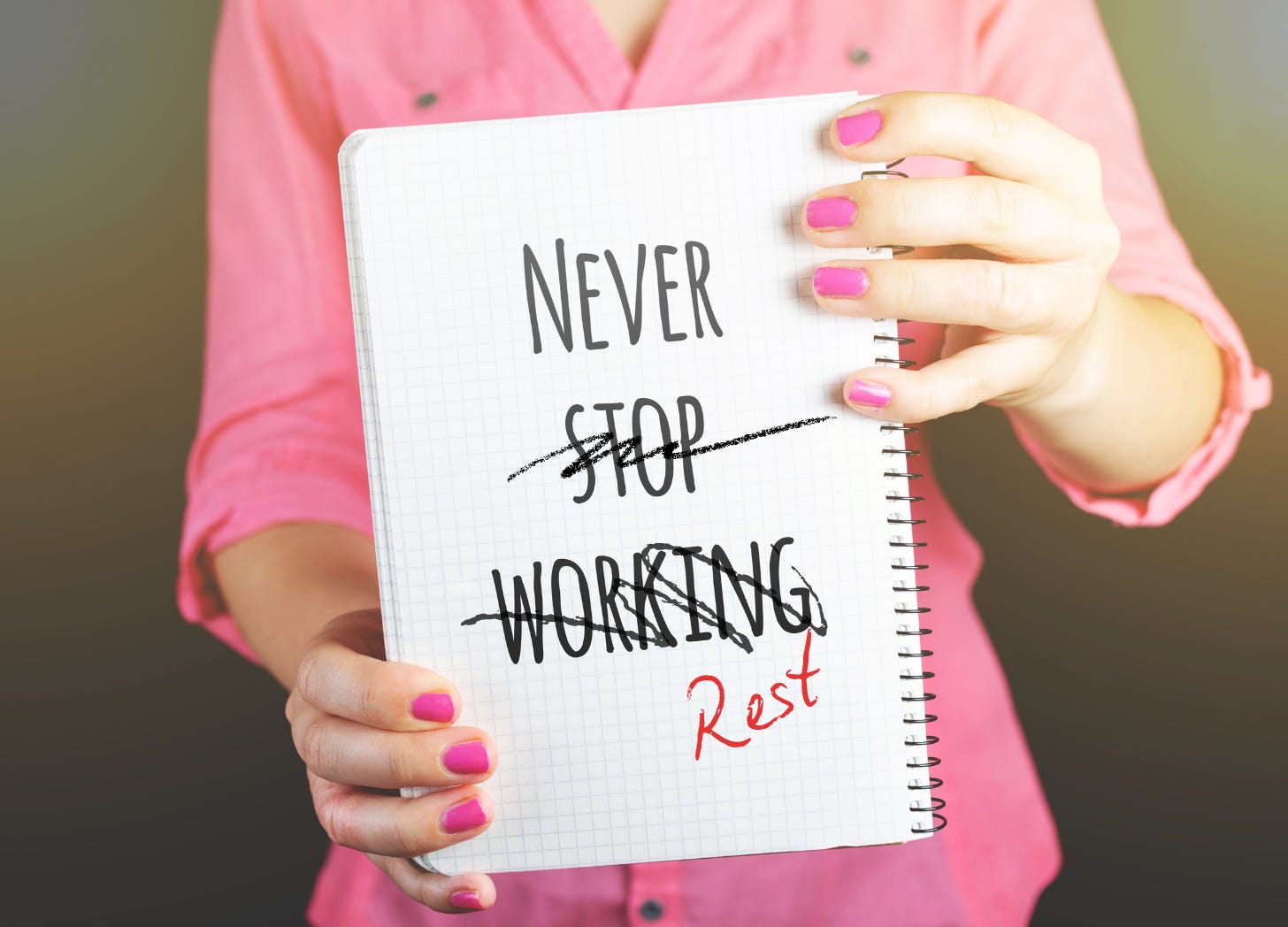
When I think of the week, I see it as a loop, not a calendar you flip as you progress day to day. I see it more like a racetrack without a finish line. Monday is the starting line, but Sunday just brings you right back to that same starting line, and you just keep racing and racing without an end in sight.
I don’t know if this is a decidedly female way to think about time, or if it’s just a Hayley way, but I do believe it explains the nervous system of any woman who has said to themselves or their family, “A woman’s work is never done.” And I believe this is a significant reason why women tend to struggle more with anxiety than men do. Once we tell ourselves that our work has no finish line, our nervous system, designed for finish lines, sees perpetual work as unsafe and, therefore, anxiety-creating.
My husband once asked a group, “What do you think is the three-word verse that most men would say is their favorite?”
“It is finished.”
“What do you think is the favorite verse of most women?”
“Does it have to literally be a verse? Or can it be, ‘A woman’s work is never done?’” Literally.
That is comical and convicting, especially in light of the fact that in order to have real peace, the human nervous system needs to see a finish line. I mean, work is tolerable as long as you can see an off-ramp in the foreseeable future, but when there are no off-ramps in sight, we just keep a running to-do list that never ever gets cleared and freaking out attempting it. In this view of life, everything is cyclical when it should be linear.
If you spend your mental presence looping over and over and over again in a stress-inducing cycle of service, at that point, your nervous system will start to treat the situation of your life like a permanent threat condition instead of a temporary demand, and chronic anxiety will be your chronic companion.
Unfortunately, most of our work has no real ending. There is no “It is finished” to the emotional vigilance required to keep the people you love happy, while at the same time managing everything else.
In truth, these aren’t individual tasks; they are one perpetual race. And then when you add boundaryless labor to moral obligation for good measure, and well, because you can, then attach your identity to it, you end up stuck in your own fight-or-flight club. And, like the original, no one talks about it.
As long as our work is never done, we end up roaming the savannah like an injured wildebeast separated from her pack, running from one room to the next, trying to escape a hungry lion. And, guess what. From a biological standpoint, your body doesn’t know the difference between a woman who never rests and a woman who is being chased by a deadly predator. You are both.
My conclusion? This is what practicing omnipotence feels like when you’re an impotent creature. And I know of which I speak. I’ve been living under the false premise that I need omnipotence in order for my world to run smoothly for decades. Saying I trust in an all-powerful God, yet having his back in all things, to-do list oriented. I mean, God doesn’t have time for all that, right? That lands squarely on my shoulders. Or so I thought.
If I were Jesus, I never would have gone to the cross because I couldn’t bring myself to say it was finished. I’d want one more swing at getting the word out; I’d feel uncomfortable leaving people unhealed and unsaved. I’d think this woman’s work is not done.
But when Jesus said, “It is finished,” almost nothing was finished. Rome was still in power. People still hated Him. His followers were weak, terrified, and running. Suffering still ruled people’s lives, and death still had its power. The world was not restored.
But He stopped.
He stopped.
Would my makeup allow me to do that? I am afraid not. Excruciating death on a cross aside, just leaving things unfinished would drive me crazy.
I only feel comfortable resting once I can achieve resolution, which is probably why faith has always felt inefficient to me. Once the counter is clear, the inbox is empty, and my people are asleep. Once my relationship feels stable and the future feels predictable, I can be happy. I mean, as long as nothing is about to fall apart, I can start to breath but still, I cannot possibly say, “It is finished” because I know it all starts over again tomorrow. No end in sight.
But maybe I’m confusing faithfulness with omnipotence, flipping the job description between me and God.
Mine is omnipotence: His is faithfulness.
Feels right.
And that is just wrong.
Seems that my to-do list isn’t just a list but my resume for Godhood. Me trying to Jesus my way through my plans, but without the actual power or call to back it up.
It’s a sickness, really, this need to micromanage God. As if the Creator of the universe is up there biting His nails, waiting for me to finally organize the pantry so He can get some real work done.
But when I try to Jesus my way through my day, I’m not being holy; it’s not “what would Jesus do,” it’s delulu. I’m staying awake all night trying to keep the planet spinning, as if my insomnia is the only thing holding the solar system together. I live with the delusions of grandeur disguised as a servant heart. I think I’m being a good girl, but I’m actually just a really bad God.
I’m starting to see that the most spiritual thing I can do today isn’t to pray more or serve more or fix one more thing, it’s to look at the half-finished, the un-repaired, and the to-be-continued and just… quit. Does that feel as wrong, and yet so right, to you as it does to me?
Face it, if I wait for resolution to rest, I’ll never rest this side of heaven. I’ve got to attempt the radical, terrifying “unfaithfulness” of leaving things undone, and trust that if I’m not there to take care of it, the world won’t actually implode.
Maybe rest was never supposed to come from resolution in the first place.
But, unfortunately, because we’ve tied rest to omniscience, we can’t stop.
“It is finished” feels so foreign in the mouth of a woman whose nervous system has spent years preparing for the total collapse of a system outside of her control.
Maybe the real question to ask isn’t, “Is my work done?” But can I believe God is still working when I am not? Thoughts to ponder.
I understand the loop and find it hard to call it a day, too.
Maybe it’s appropriate to say “It is finished for today. Tomorrow is a new day.” 🙂